The forty-second Cape Winemakers Guild Auction, held on 2 and 3 October, generated R18.22 million in sales, up 5.9 percent on 2025. More wine changed hands than a year ago, with 2,220 cases sold against 1,912 last year, an increase of 16 percent, though the average price per bottle slipped from R1,501 to R1,368.
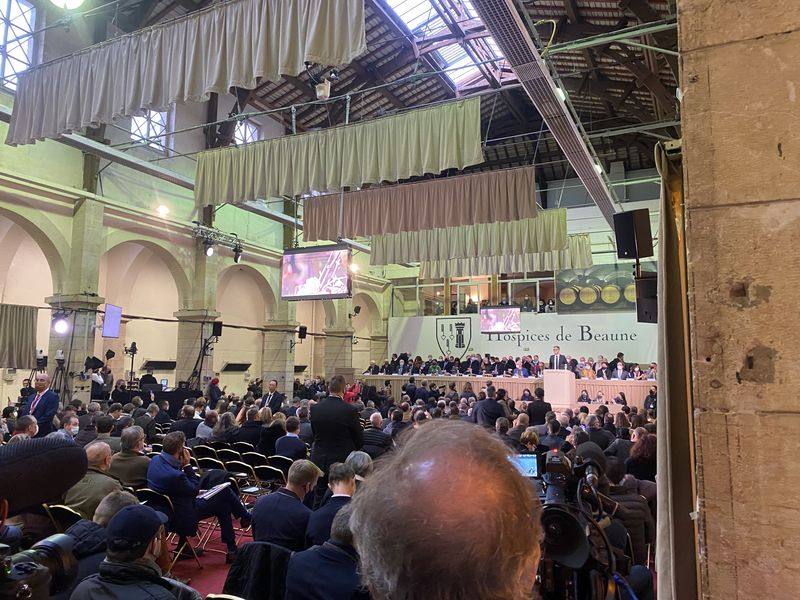
Hosted by Strauss and Co at its Brickfield Canvas saleroom in Woodstock, Cape Town, the hybrid sale, taking bids in person, online and by telephone, drew 263 registered bidders from sixteen countries. Fifty-eight wines went under the hammer: 34 reds accounting for 1,364 cases, 22 whites for 780 cases, and two Cap Classiques for 76 cases. Every wine was produced exclusively for the auction by members of the Guild.
A forty-two-year first
For the first time in the auction's forty-two-year history, white wines, including Cap Classique, achieved a higher average price than reds: R1,416 per bottle against R1,340, excluding VAT. Chenin Blanc and Chardonnay accounted for 65 percent of the white wines offered, and the result reads as a verdict on where South Africa's fine-wine momentum currently sits.
The shift is not a quirk of one catalogue. South Africa's white wines, Chenin Blanc in particular, have spent a decade building a global reputation, and the auction's top price going to a Semillon underscores where collector attention is pooling. When the lots that carry the day are whites, the old hierarchy of the Cape cellar, reds on top and whites below, starts to look like a habit rather than a rule.
The leaderboard itself tells a story about South African wine in 2026. The top price went to a Semillon, an old-vine white, followed by a Syrah, a Cabernet Franc, a Merlot and another Syrah. It is a list that would have been unrecognizable at the first Guild auctions four decades ago, when the Cape's reputation rested on a narrower bench of reds. The market has widened its palate.
The highest six-bottle-equivalent hammer prices were led by the Mullineux The Gris Old Vine Semillon 2025 at R27,500, followed by the Rall Wines Noa Syrah 2024 at R19,000, the Leeu Passant Hillside Cabernet Franc 2023 at R17,500, the Solo Wines by Carl Schultz CWG Auction Merlot 2023 at R15,000 and the Van Loggerenberg Wines CWG Auction Syrah 2025 at R13,000. The largest premium over estimate went to the Lismore Estate Vineyards Child of Venus Viognier 2025.
Who was buying
Ninety-six successful bidders shared the lots. Two private clients ranked among the top ten buyers, alongside Grootbos, Singita and the UK merchant Bordeaux Index. South African bidders accounted for 78 percent of sales, with the UK taking 7 percent and buyers from Belgium, Denmark, Germany, Hong Kong, Luxembourg, the Netherlands, Switzerland, Guernsey and Australia making up the rest. The trade represented just under 30 percent of bidders but accounted for 44 percent of the value purchased.
The buyer mix points the same way as the prices. With nearly four-fifths of sales staying in South Africa and the trade taking 44 percent of the value, the auction remains first a domestic institution, but the sixteen countries on the bidder list, and a UK merchant among the top ten buyers, show an international bench that keeps deepening. According to Strauss and Co's published results, the sale performed at 98 percent of its mid estimate, with 12 percent of lots exceeding their high estimates, a clean clearance that suggests depth rather than froth in the bidding.
Separately, the Cape Winemakers Guild Protege Auction raised R655,900 through donated wines and wine-related experiences. The money supports the Guild's Protege Programme, which provides placements and training for emerging South African winemakers.
There is a generational thread running through the weekend as well. The Protege Auction's R655,900, raised from donated wines and experiences, funds the placements and training of the Guild's emerging winemakers, the same talent pool whose wines will fill future catalogues. An auction that sells its past while funding its future has understood the assignment.
Taken together, the weekend described a market growing in breadth rather than heat: more cases, more countries, a lower average bottle price, and a new hierarchy with whites on top. In a season when the global auction conversation has been dominated by Bordeaux, the Cape's forty-second act suggests the trade is looking further afield for its excitement.