The artist-label tradition at Chateau Mouton Rothschild has been running continuously since 1945, which makes each new commission a small event in two worlds at once: wine and art. The 2023 label, unveiled in December 2025, was given to Joana Vasconcelos, the Portuguese sculptor and installation artist known for monumental works. She is the first Portuguese artist to join the lineage.
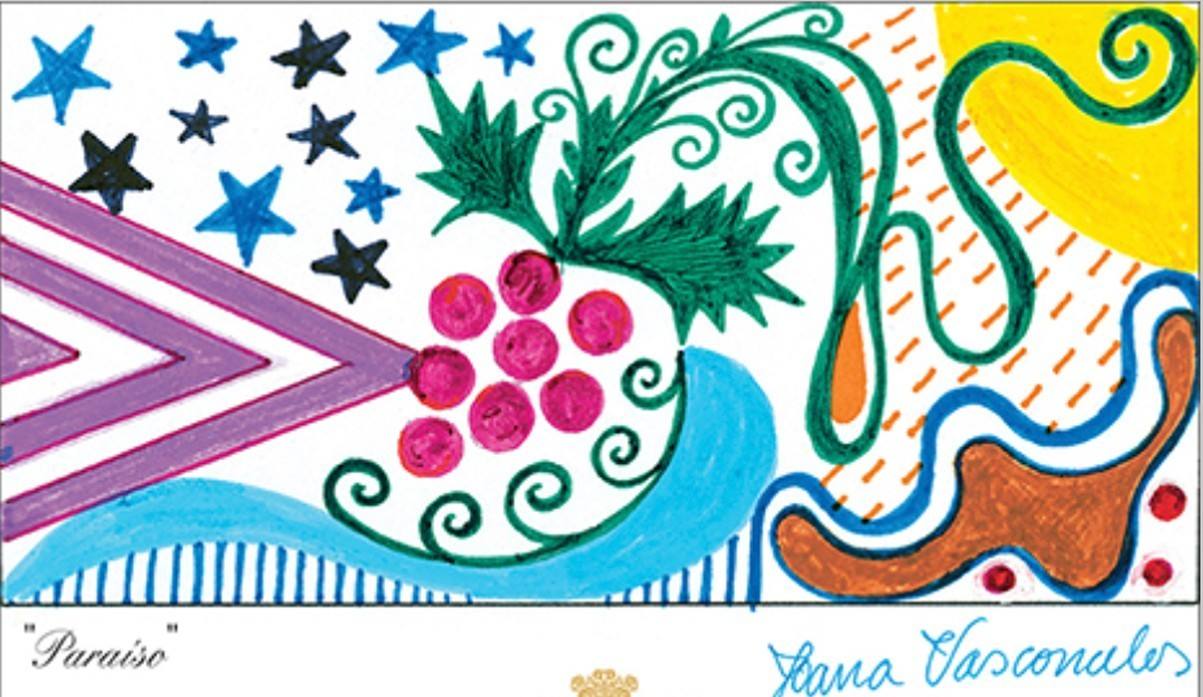
The work is a drawing titled Paraíso, or Paradise. It centers on a grape cluster, with visual references to earth, water, sunlight and night, and to human work, represented by a purple triangle. For an artist whose medium is usually scale itself, the constraint of a wine label, a few square centimetres of paper, is part of the interest.
Paradise, in ink
Vasconcelos is not, on the face of it, a label artist. Her practice is built on large-scale installations that recontextualise everyday objects and domestic craft: crochet, embroidery, stainless-steel saucepans, hand-painted azulejo tiles, assembled at monumental scale to address the status of women, consumer society and Portuguese identity.
The drawing's elements read as a compressed cosmology. Earth, water, sunlight and night are the vineyard's raw materials; the purple triangle stands for human work, the intervention that turns them into wine. It is a traditional set of symbols, rendered by an artist whose usual vocabulary is deliberately anything but traditional.
A tradition since 1945
The Mouton label lineage is one of the most documented collaborations in wine. The immediate predecessors are Gérard Garouste for the 2022 and Chiharu Shiota for the 2021; earlier in the series came Pablo Picasso, Salvador Dali, Andy Warhol, Francis Bacon and David Hockney, among many others. Each label is both a bottle and a print run, seen by collectors and drinkers in numbers no gallery exhibition can match.
The choice of Vasconcelos continues a pattern in recent commissions: artists known for installation and spatial work, brought down to the scale of the bottle. The contrast is the point. A career built on filling Versailles-sized spaces is here asked to fill a rectangle of paper, and the resulting compression becomes part of the work's meaning.
Why Portugal, why now
That Vasconcelos is the first Portuguese artist in a tradition running since 1945 is worth pausing over. The Mouton label series has long been international, but its geography has favoured the familiar centres. Portugal's absence until now is a small historical curiosity, corrected eighty years into the tradition. The timing coincides with Portuguese wine's own rising profile, though the commission is an artistic choice rather than a commercial one, and should not be read as a marketing alignment.
The unveiling in December 2025 placed Paraíso in the lineage alongside Garouste's 2022 and Shiota's 2021, and behind them Picasso, Dalí, Warhol, Bacon and Hockney. It is a lineage that confers as much as it commissions. For Vasconcelos, the label is a different kind of audience: not the museum visitor but the collector, the drinker, the cellar. Paradise, in the end, is meant to be opened, and the label is the one work of hers that arrives by the case rather than by the museum ticket.
The monumental, miniaturised
Vasconcelos, born in 1971, has a biography of firsts. In 2012 she became the first woman and the youngest artist to be given a solo exhibition at the Palace of Versailles; her 2018 retrospective I'm Your Mirror at the Guggenheim Museum Bilbao made her the first Portuguese artist to hold a solo exhibition there. Her exhibitions are among the best attended given to a living Portuguese artist.
Set against that scale, Paraíso is an exercise in restraint, and perhaps a canny one. The Mouton label is one of the few commissions in art where the audience is guaranteed and the format is fixed. Vasconcelos met both with a drawing of a grape cluster and a small purple triangle: paradise, and the human work required to reach it.