Germany's winegrowers have just lived through the arithmetic of scarcity. Final figures put the 2025 harvest at 7.55 million hectolitres of wine and must, 2.6 percent below 2024 and about ten percent under the 2019 to 2024 average. The cause was not one disaster but a sequence: small berries, low must yields, and heavy September rain that forced growers to select ruthlessly or lose the crop.
The pain was concentrated where most German wine is made. Rheinhessen, the country's largest region, and the Pfalz each harvested around 14 percent less than the year before. Against the trend, the Mosel, Baden, Wurttemberg and Franconia all produced more than in 2024, while Saxony and the Ahr, which frost had punished the year before, posted strong gains. The national vineyard area shrank by 1.1 percent.
Small, but very good
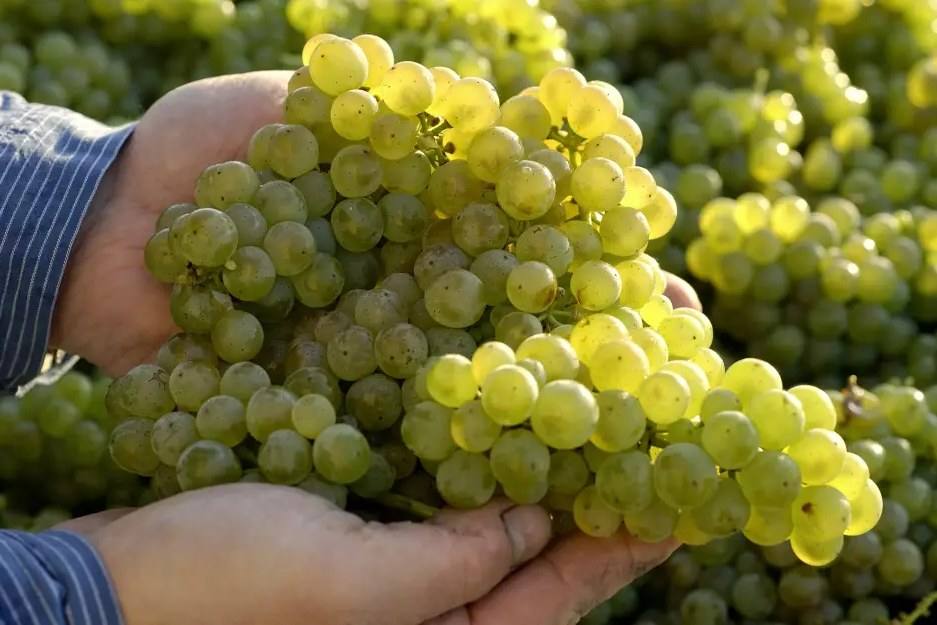
What the short harvest lacked in volume it recovered in quality. The share of Pradikat wine, the top quality tier, rose from 16.1 percent to 29.3 percent, nearly doubling, as only the healthiest fruit made it to the press. White wine accounted for roughly two-thirds of production. Small berries mean concentrated juice; ruthless selection after the September rains meant concentration across the board.
The German Wine Institute had flagged the vintage's promise early. When the main harvest began in early September 2025, about three weeks ahead of the long-term average in the Rheingau, the institute reported healthy grapes with high must weights and appealing acidity, development comparable to the 2003 and 2018 vintages, and expectations of fresh, fruity, aromatic whites and full-bodied reds. The September rains then cut the crop but not, by the institute's account, the quality.
The dry turn
The more structural story of 2025 is not the harvest's size but its style. New German Wine Institute figures from quality-wine testing show that 53 percent of Germany's tested quality and predicate wines were made dry in 2025, a point up on 2024, and a long way from 48 percent in 2020 and 40 percent in 2010. Among sparkling wines, 54 percent now fall into the brut nature to brut categories, against 50 percent five years ago. Sweet and semi-sweet wines lost another point of share and sit eight points below their 2010 level; semi-dry held at 19 percent.
The colour of German wine is shifting too. White accounted for 70 percent of tested quality and predicate wines in 2025, red for 17 percent and rose for 13 percent. In 2010, red still held 33 percent. The Germany of the international imagination, all honeyed Riesling and old-fashioned sweetness, is being replaced, statistically, by something drier and whiter.
What scarcity means
A short, good vintage is the trade's favourite problem until the invoices arrive. Less wine to sell sharpens every other pressure: the cost of the selection that saved quality, the allocations that will shrink for importers. Bulk wine prices remain under severe pressure, with some lots trading at 40 to 60 cents a litre against production costs around 1.20 euros. Quality, however real, does not automatically pay for quantity lost.
But there is a longer signal in the quality statistics. The Pradikat share nearly doubled in a single year, and the dry share has climbed at every published checkpoint, from 40 percent in 2010 to 48 percent in 2020 to 53 percent in 2025. The 2025 vintage, small and concentrated, is likely to suit that style precisely. If the vintage is remembered, it may be less for what the weather took than for what the cellars chose.