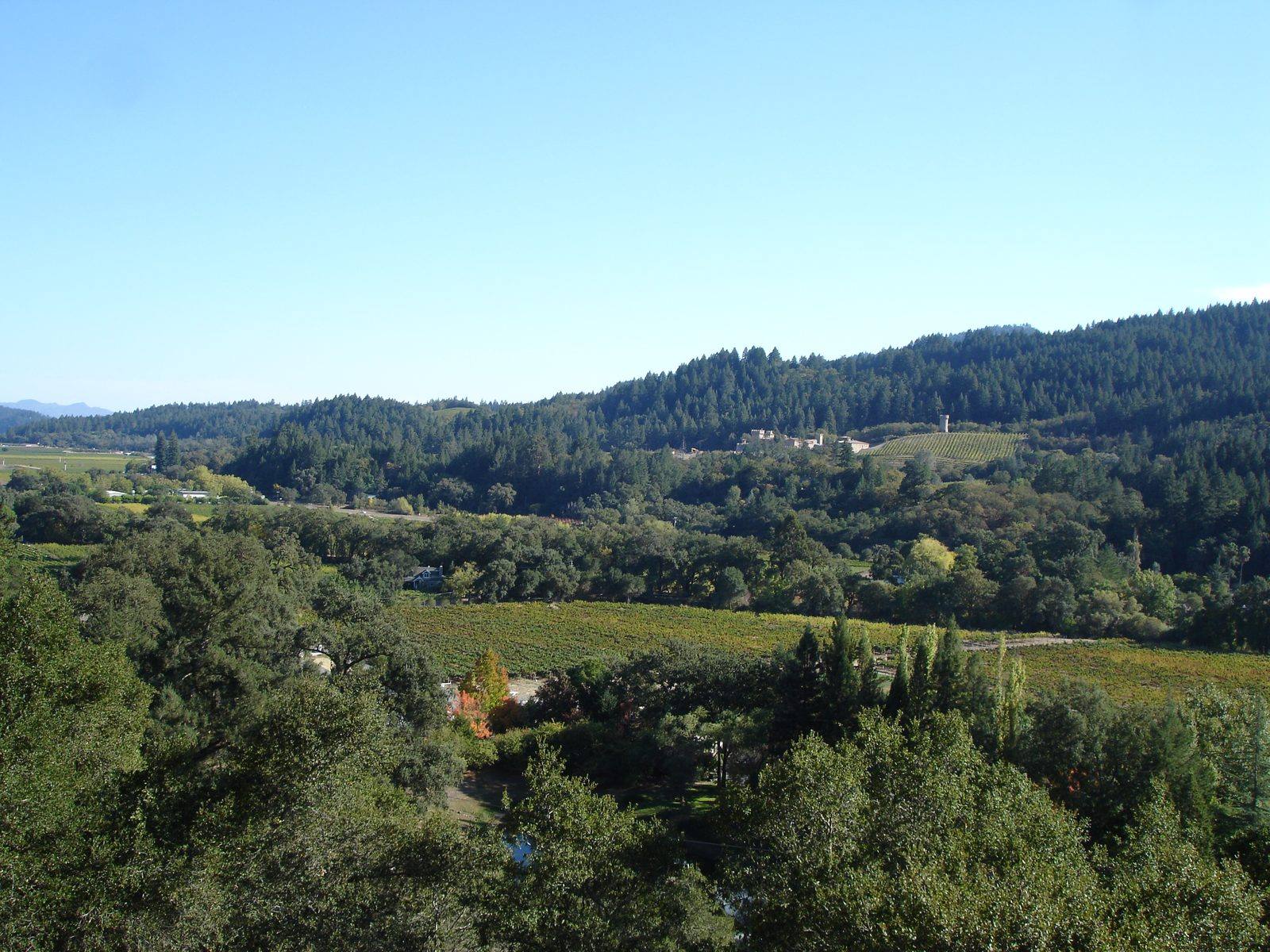
On either flank of Napa Valley, harvest looks different from the floor below. Vineyards on Howell Mountain and in the Spring Mountain District begin above the fog line, where the morning sun arrives earlier, the nights stay warmer, and the growing season runs long. In 2025, these two mountain appellations, one the valley's first sub-appellation and the other its most storied hillside, walked into the same vintage with the same questions: whether a cool summer would ripen evenly, and how far the smoke from the Pickett Fire would reach.
Two ridgelines, two temperaments
Howell Mountain was recognized as an appellation in January 1984, making it Napa Valley's first sub-appellation. Its vineyards sit between roughly 1,400 and 2,200 feet on the Vaca Range, above the fog that settles over the valley floor, on volcanic soils with red clay and tufa that drain freely and keep vine vigor low. Annual rainfall runs around 40 inches, generous by Napa standards, and the principal varieties are Cabernet Sauvignon, Merlot, Zinfandel and Viognier.
The Spring Mountain District, on the Mayacamas range west of St. Helena, was established as an AVA in 1993. It covers about 8,600 acres, of which roughly 1,000 are planted, with some 22 wineries and 30 vineyards working elevations from 400 feet to nearly 2,600 feet. The climate is classified Region II, with cooler days and warmer nights than the valley floor: most vineyards sit above the fog line so mornings warm quickly, while afternoons are cooled earlier by maritime winds off the Pacific. Rainfall can run more than double the valley floor's, reaching 67 inches in wet seasons. The soils are entirely residual upland soils, with no alluvial deposits, made up almost equally of Franciscan sedimentary rocks and Sonoma Volcanics. Red varieties account for 81 percent of vineyard acres, with Cabernet Sauvignon making up more than half and Merlot more than a quarter; Chardonnay predominates among the whites, alongside Riesling, Chenin Blanc, Sauvignon Blanc, Viognier and Muscat.
A century and a half of hillside history
Spring Mountain's documented vineyard plantings reach back to the late 1800s. Grape growing and winemaking declined between 1910 and 1940 with phylloxera and Prohibition, and the first reawakening came in 1946, when Fred and Eleanor McCrea planted a small vineyard north of Mill Creek and then, in 1953, founded the legendary Stony Hill. The resurgence began in earnest in the late 1960s and 1970s with the founding of Ritchie Creek, Yverdon, now Fife, Spring Mountain Winery, Smith-Madrone and Robert Keenan.
Smith-Madrone's story is among the most consequential in American wine. In 1971, the twenty-two-year-old Stuart Smith bought 200 acres of abandoned vineyard land on Spring Mountain with his brother Charles. In 1979 they entered their first vintage of Riesling, the 1977, in a 'Wine Olympics' of sorts sponsored by the French publication Gault-Millau, and took the best Riesling prize over German and French competitors. Smith went on to petition the federal Tax and Trade Bureau, by typewriter and U.S. mail, to make 'Riesling' the correct domestic label name for the grape, displacing the incorrect Johannisberg Riesling and White Riesling then in use.
The 2025 season, as told from above
Napa Valley saw a largely even and cool summer in 2025, and the mountain fruit needed careful handling. Barrett Anderson, winemaker at Spring Mountain, told Decanter that the cool conditions required careful canopy management just after fruit set to limit pyrazines in Cabernet Sauvignon and other Bordeaux varieties, and that he remained worried about late-season heat spikes. The Pickett Fire near Calistoga, still burning and nearly 90 percent contained as of early September, raised smoke concerns across the region. Anderson had one Howell Mountain vineyard that may have been smoke-exposed, and told Decanter that samples would be sent to laboratories for testing. Spring Mountain itself lost more than half its vineyards, about 40 hectares, along with the historic 1870s La Perla winery, in the 2020 Glass Fire, so the caution around smoke is institutional, not theoretical.
We will be sending samples to labs for testing.
Barrett Anderson, winemaker, Spring Mountain, Decanter California 2025 harvest report
The September dispatches from the mountain were cautiously optimistic. Laura Barrett, winemaker at Clif Family Winery, reported harvesting Zinfandel from Home Farm, 'technically below the AVA line at about 1,250 feet, but it's still on the mountain,' with the Cabernet at Croquet Vineyard sitting near 25 Brix and 'just a few more weeks' from picking. Mia Klein of Cimarossa on Howell Mountain called the vintage 'looking good with healthy leaves, hardened canes, growth attenuated, and the fruit is in good shape,' while noting that 'much depends on the weather for the rest of ripening' and that it was about 'keeping the fruit and basal leaves in good condition.' Her summary of the mood: 'crossing fingers for a mild September that gives way to a busy October.'
On Spring Mountain, Stuart Smith of Smith-Madrone reported that harvest was underway: Matt Gardner at Keenan had almost finished Chardonnay and harvested a small block of Cabernet Sauvignon, Andy Schweiger had harvested Pinot Noir and a small block of Merlot, John Gantner at School House would pick Chardonnay on Wednesday and Pinot Noir on Thursday, Smith-Madrone would finish Chardonnay on Wednesday and move straight into Riesling, and Reid Griggs at Stony Hill was 'super happy with his Chardonnay harvest' and would start Riesling on Tuesday evening. The cellar verdict, in Smith's words: 'overall, the grape chemistry is fabulous with slightly higher sugars than normal, but with sky-high acids and very low pHs.'
What the mountains decide
Placed side by side, the two appellations read as variations on the same mountain theme, different soils, different histories, the same altitude-driven logic.
- Howell Mountain AVA, recognized 1984: vineyards above 1,400 feet on the Vaca Range; volcanic soils, red clay and tufa; Cabernet Sauvignon, Merlot, Zinfandel and Viognier the principal varieties.
- Spring Mountain District AVA, established 1993: about 8,600 acres with roughly 1,000 planted, 400 to nearly 2,600 feet on the Mayacamas; residual upland soils mixing Franciscan sedimentary rock and Sonoma Volcanics; Cabernet Sauvignon dominant, Chardonnay the leading white.
The 2025 wines are years from release, and the smoke question will be answered in the laboratory before it is answered in the glass. What is known is that both mountains faced the year the way mountain appellations always do: with more sun than the floor, more wind, more patience, and this time a fire on the horizon. The fog line marks more than an altitude. It marks a different relationship with risk, one the 2025 vintage made impossible to ignore.