Burgundy entered the 2025 growing season with recent memory of loss. The 2024 vintage had been savaged by mildew, and volumes at some domaines collapsed to a fraction of normal. The 2025 season offered no simple redemption. It offered heat, then rain, an early start and a drawn-out harvest, and a region in which averages concealed as much as they revealed.
The national picture, as reported by France's agriculture ministry Agreste on 9 September 2025, was recovery: national production of 37.4 million hectolitres, about 3 percent above 2024 but still 13 percent below the five-year average. Burgundy's volumes rebounded 45 percent on 2024, and the Jura doubled its output. Champagne's authorised rendement was lowered to 9,000 kg/ha, a reminder that the vintage's generosity was not uniform.
The national picture, and its limits
A 45 percent rebound sounds like abundance until it is set against what it rebounded from. The domaine-level figures tell the sharper story. Domaine de l'Arlot produced 8 hl/ha in 2024 and 16 hl/ha in 2025, against 38 and 42 hl/ha in 2022 and 2023. Doubling a disastrous volume still leaves a small one. Domaine de la Vougeraie produced 82,000 bottles in 2024 against 105,000 in 2025, while Domaine Jean Grivot made 83 barrels of Pinot Noir in 2024 against 314 in 2023. The recovery was real, but the baseline had been so low that many cellars remained thin.
This is the arithmetic of two successive small vintages. A rebound on 2024 flatters the percentage; the five-year comparison, 13 percent below average nationally, is the truer measure of where French wine stands. Burgundy sold relief in 2025, but not plenty.
Two halves in the vineyard
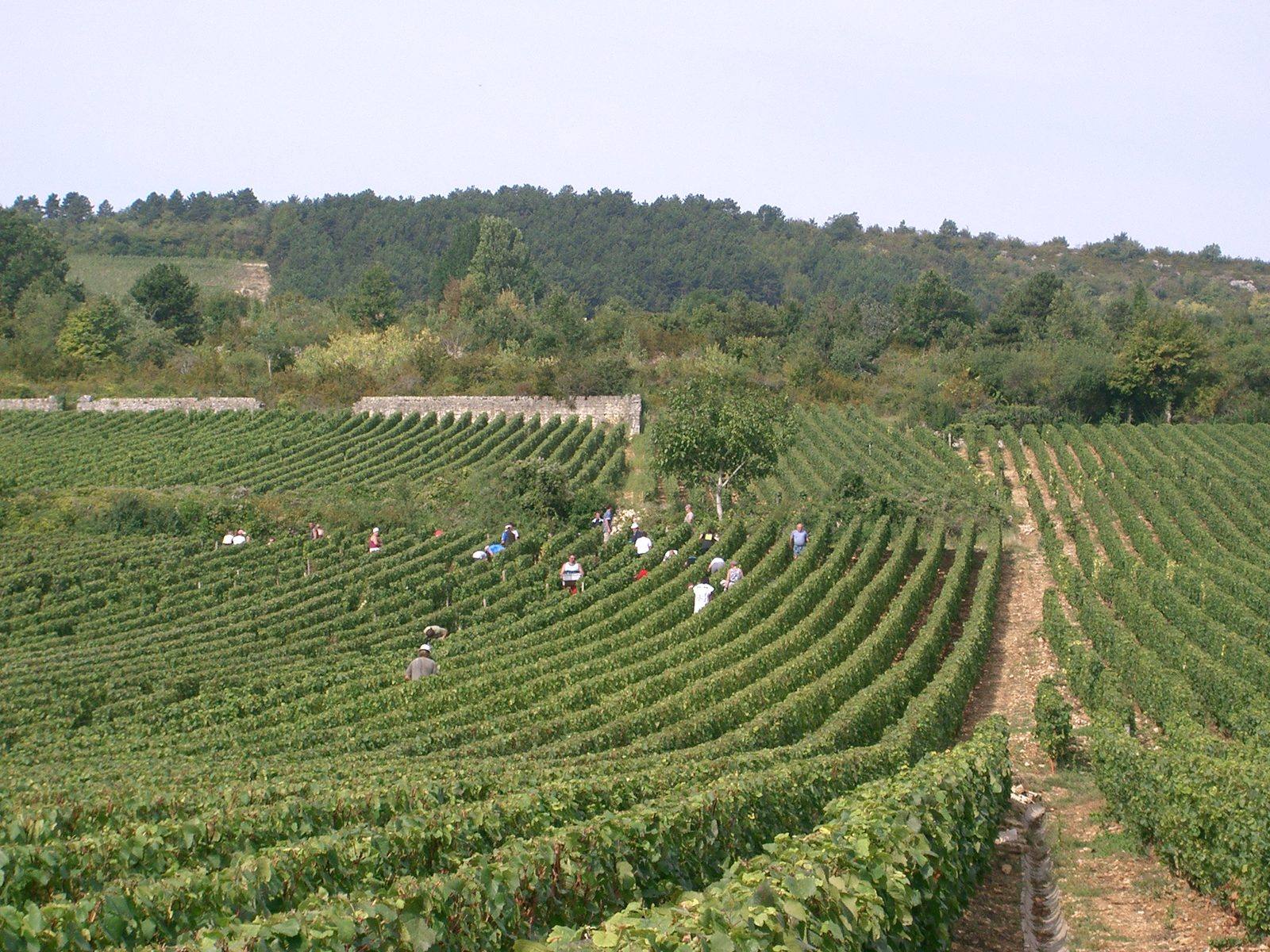
The clearest account of the season comes from Domaine Jean Monnier et Fils, whose harvest report covers vines in Meursault, Puligny, Volnay, Pommard and Beaune. Budburst began in early April, with mid-budburst around 8 April. Heatwaves struck in the second half of June and again from 8 to 18 August. The Cremant harvest began from 18 August, and the main harvest ran from 21 to 29 August 2025, split into two phases by rainfall. The season, in other words, ran hot and fast, then stopped for rain, then finished under pressure.
The same report describes small berries, deep colour in the reds and preserved acidity, with red volumes below average. Laithwaites' buyers, reporting on the 2025s, describe an early start and a drawn-out harvest with mixed ripeness: Chablis, in their word, was happy, while small berries and punchy alcohols marked the picture elsewhere. The phrase that keeps recurring is mixed ripeness, the vintage's signature and its risk.
Chablis, the exception
Laithwaites' buyers singled out Chablis as happy, a small word doing a lot of work. In a vintage defined by mixed ripeness and punchy alcohols, Chablis appears to have found a balance that eluded others. The domaine-level reports do not explain why in detail, and the research deliberately avoids broad quality claims, but the contrast was noted by buyers who tasted across the region. Exceptions matter in vintages like 2025: they show what the season allowed when conditions aligned.
The economics of a thin cellar
Two small vintages in a row reshape a domaine's business, not just its wines. Domaine de l'Arlot's 16 hl/ha in 2025, double the 8 hl/ha of 2024, is still less than half of its 2022 and 2023 volumes. Domaine Jean Grivot's 83 barrels of Pinot Noir in 2024 against 314 in 2023 is the same arithmetic. When volumes halve, something has to give: allocations shrink, prices face pressure, and the 2025s will be asked to do the commercial work of two vintages. The rebound in the Agreste figures is real, but it is a rebound measured against a collapse.
A recovery in context
Burgundy's 45 percent rebound was not the national story's most dramatic chapter. The Jura's volumes rose 200 percent on 2024, a figure that says more about the previous year's devastation than about abundance. Champagne's authorised rendement was lowered to 9,000 kg/ha, a deliberate restraint in a region that could have taken more. Set beside those, Burgundy's recovery looks like the middle of a patchy national picture: better than the disaster it followed, smaller than the average it trails, and uneven in ways the aggregate figures cannot show.
That is the shape of French wine in 2025. Not a return to normal but a series of local recoveries, each measured against its own worst year. Burgundy's version was decided in the vineyard weeks, in the picking dates and the sorting tables, and it will be judged, when it is judged, the same way: domaine by domaine, parcel by parcel.
Reading the vintage honestly
What can be said is that 2025 was not a rescue and not a catastrophe. It was a working vintage in a difficult run: better fruit than 2024 for many, smaller than normal almost everywhere, heterogeneous in ways that will only become clear as the wines age. Burgundy in 2025 was decided the way its vintages are increasingly decided, parcel by parcel and week by week, with the weather changing the question halfway through.